
Buying the wrong HR software is an expensive mistake. You spend weeks moving all your employee data, only to find out the new system cannot handle Nepal’s specific SSF calculations, TDS rules, or Dashain bonuses. Suddenly, you are right back to doing payroll on messy Excel sheets.
With so many local and international tools making big promises, comparing them all takes hours you do not have. Whether you run the HR department of a growing company, a startup, or a law firm in Nepal, choosing the right HR software can save countless hours every month.
In this guide, we cut through the noise and review the top 5 HR software in Nepal for 2026. We will compare their real features, local compliance, and pricing so you can choose the right system today.
What is HR Software and Why Do Businesses in Nepal Need It?
HR software is a digital system that helps companies manage their employees from the day they join until the day they leave. For years, Nepali businesses have run their offices using thick register books, WhatsApp groups for leave approvals, and heavy Excel sheets to calculate monthly salaries. HR software brings all these scattered tasks into one organized place.
If you are running a business in Nepal today, you already know that managing staff the old-fashioned way wastes too much time and leaves room for mistakes. Government rules are getting stricter, and keeping track of everything on paper simply does not work anymore.
Here is exactly why companies in Nepal need a dedicated HR system right now:
- Solving the Payroll Headache: Calculating salaries in Nepal is not a simple math problem. Every month, you have to separate the basic salary from allowances. Then, you must calculate the 11% and 20% contributions for the Social Security Fund (SSF), manage Citizen Investment Trust (CIT) amounts, and figure out the exact TDS tax slabs for each person. Doing this manually for a growing team takes days. Software finishes it in minutes with zero errors.
- Stopping the WhatsApp Leave Mess: Tracking sick leave, casual leave, and festival holidays over text messages causes confusion. With an HR app, employees can check their own leave balance and apply directly from their phones. Managers can approve it with one click, and the system automatically updates the final records.
- Connecting the Fingerprint Machine: Almost every office in Kathmandu has an attendance machine at the door. However, at the end of the month, someone usually has to download that data using a pen drive and match it manually with the leave records. Good HR software connects directly to your biometric device and records exact working hours automatically.
- Staying Safe from Government Fines: Nepal’s labor laws change, and new tax rates come out after every national budget speech. SSF reporting is also heavily enforced now. A local HR system automatically updates these legal rules, making sure your business stays safe from heavy fines and legal trouble.
- Keeping Data Safe and Easy to Find: Storing physical citizenship copies, contracts, and CVs in a metal cabinet is risky. Software keeps employee records safe online, so you can find any document in seconds without digging through dusty folders.
Key Features to Look for in HR Software in Nepal
Picking the right HR software means looking closely at what it actually does. You do not want to pay for fancy tools your team will never touch. Instead, you need a system that solves your daily office problems here in Nepal. Here are the five most important things your new software must have before you buy it.
1. Payroll Management and Tax Compliance
Doing payroll by hand in Nepal is a nightmare. Your HR software must calculate salaries without you doing the math. It needs to automatically separate the basic salary from other allowances. The biggest thing to check is if it handles the Social Security Fund (SSF) rules properly. It also needs to calculate the correct TDS tax slabs for married and unmarried staff. If your team uses the Citizen Investment Trust (CIT), the software should track that too.
Every year, the government changes tax rules during the budget speech. A good local software will update these new rules automatically, so you do not make mistakes. This saves you from getting heavy fines from the tax office later.
2. Attendance and Leave Management System
Keeping track of who is late or absent takes up too much time. Your new system must connect directly to your office fingerprint or face scan machine. This means you do not have to download attendance data using a pen drive anymore. The software should show you exactly who came on time and who left early. It also needs a clear way to handle different types of holidays.
Staff should be able to ask for sick leave or casual leave through the system. The manager can simply click a button to say yes or no. Once approved, the software must update the final leave balance on its own. This stops the endless phone calls and text messages asking for days off.
3. Employee Self-Service Portal
HR managers spend hours answering basic questions from the staff. A good HR software gives every worker their own private account. They can log in from their mobile phone or office computer. Inside this account, they can view their own salary slips from past months. They can also check how many leave days they have left for the year.
If they need to change their bank details or phone number, they can do it themselves. They can even see office announcements or the yearly holiday list without asking anyone. This feature makes the staff feel more trusted and in control of their work life. It also frees up the HR team to focus on bigger tasks instead of digging up old paper files.
4. Performance Management and Reporting
You need to know who is working hard and who is falling behind. Your software should help you track what your employees do every month. Managers can use it to set clear goals for their team members. At the end of the year, this makes the salary review process much fairer. You do not have to guess who deserves a raise or a promotion.
The system keeps a record of all the good work and the warnings, too. Besides checking performance, the software must give you easy reports. You should be able to print a clean report of the monthly office expenses or total overtime hours. Reading these simple reports helps you make smart choices for your growing business.
5. Integration and Scalability
Your HR software should not live in a bubble away from your other office work. It needs to talk easily with the tools you already use every day. For example, it should send the final payroll numbers straight to your accounting software, like Tally. This stops your accountant from typing the same numbers twice and making spelling mistakes. You also need to think about the future of your company.
Right now, you might only have twenty people working in your office. But what happens when you hire fifty more people next year? The software must be able to handle a larger team without freezing or crashing. You want a system that grows step by step alongside your actual business.
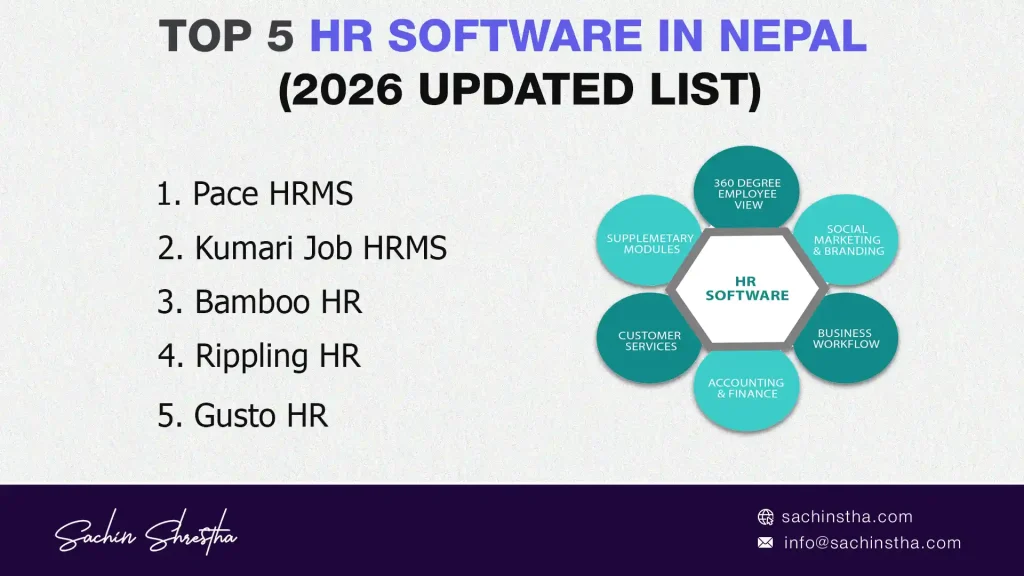
Top 5 HR Software in Nepal (2026 Updated List)
Now that you know what to look for, it is time to see what is actually available in the market. We have tested and compared the most popular systems used by companies right now. Some of these are built locally here in Kathmandu, while others are famous international brands. Here is our updated list of the top 5 HR software options for Nepali businesses in 2026.
1. Pace HRMS
If you are running a business in Nepal, Pace HRMS is simply the best system you can buy right now. It is built locally by The Pace Infosys, which means it completely understands the real problems Nepali managers face every single day. Unlike foreign software that struggles with our rules, Pace HRMS is fully designed for local tax laws. It calculates the exact 11% and 20% for the Social Security Fund (SSF) without any errors. It also handles the tricky TDS tax slabs for married and unmarried staff perfectly, saving your accountant hours of frustrating math. The system is cloud-based, so your HR team can work from anywhere without needing a heavy office server.
Here are the main reasons why Pace HRMS is the top choice for local companies:
- Perfect Tax Math: It handles all Nepal government rules like SSF, CIT, and TDS automatically.
- Easy Attendance: It connects straight to your fingerprint or face scan machine to track late days and overtime.
- Local Support Team: If you ever get stuck, a friendly team in Kathmandu will help you out immediately in Nepali.
- Grows With You: Whether you have ten staff members or five hundred, the software runs smoothly and never crashes.
With excellent customer support right here in Kathmandu, it solves your problems fast and keeps your office running perfectly. Pace HRMS is the smart choice if you want peace of mind and zero payroll mistakes for your business.
2. Kumari Job HRMS
Kumari Job HRMS is another local system built specifically for the Nepali market. It is a slightly good option for companies that want to focus mainly on hiring new staff and tracking daily attendance. The software connects easily with most biometric fingerprint devices used in local offices. It includes a central database where you can safely store employee details and old contracts. The payroll feature can calculate basic local taxes and Social Security Fund amounts.
One helpful tool in this system is its asset management feature. This allows you to track which employee is using the office laptop or company mobile phone. It also has a clear process for when an employee leaves the company, making the final paperwork easier. Employees get a self-service portal to check their own holiday balances. The support team is based in Nepal, which helps when you need quick answers. Overall, it does a decent job of handling basic HR tasks for growing teams.
3. Bamboo HR
Bamboo HR is a very famous international software used by companies all over the world. It focuses heavily on keeping employee records organized in one clean digital space. The system allows managers to track employee performance and set yearly goals. Employees can use the mobile app to request time off or check the company holiday calendar. The software generates standard reports to show how many people are joining or leaving the company. It charges a monthly fee based on the exact number of employees you have. The screens are designed to be colorful and easy for normal staff to read. The customer support team is based in the United States and operates in English.
4. Rippling HR
Rippling HR is a large platform that combines human resources with office technology management. It allows business owners to manage their staff payroll and employee benefits in one place. One unique feature is its ability to control office computers and software access remotely. It tracks total working hours and sends this data straight to the payroll system. The software provides tools to design custom training courses for new workers. It handles payments for both full-time office staff and independent freelance workers. The pricing model changes depending on which specific tools the company decides to turn on. Support is handled entirely online through chat and email systems from their main international offices.
5. Gusto HR
Gusto HR is a digital platform built primarily to handle payroll and staff benefits. It processes monthly salaries and sends the money directly to employee bank accounts. The system tracks basic attendance and matches the daily hours to the final payment. It provides digital forms for new employees to fill out before their first day of work. The software stores all previous salary slips in an online folder for staff to download. Managers can use the system to track project budgets and total labor costs. Users must pay a base software fee plus an extra cost for every person on the payroll. The main company headquarters is located outside of Nepal, so it follows global software standards.
How to Choose the Best HR Software in Nepal?
To choose the best HR software in Nepal, you must match your specific daily office problems with a system that strictly follows local tax laws and fits your budget. Do not just buy the first famous brand you see on Facebook or Google. Take your time to test a few options, ask the right questions, and make sure your staff can actually use it without a headache.
1. Identify Your Business Needs
Before looking at any software, sit down and write out your biggest daily office problems. Are you wasting too much time doing payroll by hand? Is tracking leave requests on WhatsApp driving you crazy? Maybe your main issue is keeping safe records of old employee documents. You need to know exactly what is broken in your office before you buy anything to fix it. Do not get distracted by extra features that sound cool but do not help your team.
A small shop in Kathmandu needs different things than a big tech company. Talk to your HR manager and your accountant to see what they struggle with the most. Ask your regular staff what makes their daily work annoying. Make a clear list of “must-have” tools and “nice-to-have” tools. This simple list will be your shopping guide. Focus only on the tools that will actually save you hours every single week.
2. Compare Pricing and ROI
You have to look very closely at how these companies charge you money. Some HR software charges a flat fee every month, while others charge you for every single employee. If you plan to hire many new people this year, a “per employee” cost can get very expensive very fast. Always ask about hidden fees before you sign any paper. Do they charge extra money to set up the system on your first day? Will you have to pay more for customer support when the system breaks down? You should also think about the money this software will save you.
This is what people call the return on your investment. If a system costs five thousand rupees a month but saves your accountant three days of work, it is worth the price. It is better to pay a little more for a system that works perfectly than to buy cheap software that causes mistakes. Always compare at least three different price plans side by side. Make sure the final price fits your real company budget for the whole year.
3. Check Local Compliance and Support
This is the most critical step for any business operating in Nepal. Foreign software might look beautiful, but it is useless if it cannot calculate our local taxes. You must ask the company directly if their system handles Nepal’s Social Security Fund (SSF) rules properly. It also needs to calculate the exact TDS tax slabs for both married and unmarried staff perfectly. Ask them how fast they update the software when the government changes tax rules during the yearly budget speech.
If the system does not do this automatically, you will end up doing the math yourself anyway. Good software is only half the battle; you also need good people behind it. Things will go wrong, and you will need help fixing them quickly. Ask if their support team is based here in Nepal and speaks Nepali. Check if they answer the phone quickly during your normal office hours. You do not want to wait three days for an email reply when your payroll is stuck. A strong local support team will save you from major stress every single month.
4. Evaluate Ease of Use and UI
The best software in the world is completely useless if your staff refuses to use it. You have to remember that not everyone in your office is good with computers. The screens should look clean, simple, and very easy to read. An employee should be able to ask for sick leave in just two or three clicks. The HR manager should be able to find a specific document without clicking through ten different confusing menus. A system that is hard to learn will just make your team angry and slow them down.
Before you buy, ask yourself if your oldest employee could figure out how to check their salary slip on this system. The mobile app needs to be just as easy to use as the computer version. People will use their phones for this mostly, so the phone app cannot be slow or broken. If a system takes a whole week of training just to understand the basics, it is too complicated. Choose a tool that feels natural and makes sense right away. Simple screens always beat messy screens packed with too many buttons.
5. Read Reviews and Request Demo
Never trust what a software company says about its own product on its website. You need to find out what other Nepali business owners are saying about it. Look for reviews on Google or ask other founders in your network what they use. Pay close attention to complaints about bad customer service or wrong tax calculations. Once you find a system with good feedback, you must ask for a live test drive. This is called requesting a demo. Do not just watch a recorded video; make the salesperson show you exactly how to do your specific daily tasks.
Ask them to show you how to add a new employee, run a monthly payroll, and fix an attendance mistake. Make sure the system feels fast and does not freeze while they are showing it to you. Give your HR manager access to this test version so they can try it themselves. Let them click around for a few days to see if they actually like it. Taking this final test step will stop you from making a huge, expensive mistake.
Which is the Best HR Software For Nepali Businesses?
If you are looking for the absolute best HR software for a Nepali business, Pace HRMS is the clear winner. Unlike famous foreign brands, this system was built right here in Kathmandu. It perfectly understands our local office problems. You do not have to worry about doing complex tax math by hand anymore. The software automatically calculates the exact Social Security Fund and TDS amounts without any mistakes.
Besides fixing your payroll headaches, Pace HRMS makes daily office life much easier for everyone. It connects directly to your fingerprint machine to track exact attendance automatically. With a friendly local support team ready to help you anytime, it is the safest choice to grow your company smoothly.
Benefits of Using HR Software for Nepali Businesses
Switching to HR software changes how your whole office runs every single day. You stop wasting time on boring paper tasks and start focusing on growing your business. It is not just about keeping the HR manager happy, either. A good system makes work better for every single person on your team.
1. Time-Saving Automation
Think about how many hours your team spends typing data into Excel sheets every month. HR software takes all those boring, repetitive jobs and does them instantly. When a new person joins the company, the system automatically creates their profile and sets up their payroll. You no longer have to manually type their bank details and citizenship numbers into three different places.
Calculating monthly attendance used to take a whole week of checking the fingerprint machine records. Now, the software pulls that data on its own and matches it with approved leave days. It also sends out salary slips to everyone with just one click on payday. This means your HR staff can finally stop doing robotic typing work. Instead, they can spend their time actually helping your employees and improving the office culture.
2. Improved Accuracy and Reduced Errors
Human beings get tired and make mistakes, especially when staring at numbers all day long. A small typing mistake in an Excel sheet can ruin someone’s monthly salary. HR software uses exact math formulas that never get tired or confused. It calculates the exact 11% and 20% for the Social Security Fund without failing. The system knows exactly how much TDS to deduct based on the latest government rules. It also tracks the exact number of sick days taken, so nobody gets paid for days they missed.
If a staff member takes unpaid leave, the software adjusts their final pay automatically. You never have to worry about accidentally paying someone too much or too little again. Fixing a wrong salary payment takes days of explaining and apologizing to the bank and the employee. This system stops those embarrassing mistakes before they even happen.
3. Better Employee Experience
Nobody likes chasing the HR manager just to ask for a simple day off. When you use HR software, your staff feel much more respected and trusted. They get their own app on their phone to check their leave balance whenever they want. If they need to apply for a festival holiday, they just tap a few buttons. They also get their salary slip delivered straight to their email on the exact same day every month.
If they need a copy of an old salary slip for a bank loan, they can download it themselves. They do not have to beg anyone or wait three days for a simple piece of paper. The whole process is clear and fair for everyone in the office. Happy employees who do not have to fight for basic information usually stay with your company longer.
4. Data-Driven Decision Making
Running a business based on guesses is a very fast way to lose money. You need real numbers to know what is actually happening inside your company. HR software collects all the daily information and turns it into easy charts. You can see exactly which department is doing too much overtime this month. The system also shows you if too many people are taking sick leave at the same time.
If a lot of staff members are leaving the company, the reports will help you see why. You can check the history of your hiring costs to plan your budget for next year. Having these clear reports helps you make smart choices instead of just hoping for the best. When you go to a management meeting, you will have hard proof to back up your ideas.
Common Mistakes to Avoid When Choosing HR Software
Buying an HR system is a big step, but many business owners rush and make costly errors. They often buy the first software they see online without checking if it actually fits their office. Later, they find out the new system just makes their daily work much harder. Here are the biggest traps you need to dodge before spending a single rupee.
1. Ignoring Scalability
You might only have ten employees right now, so a tiny, basic system seems fine. But what happens when your business grows to fifty people next year? Cheap software will crash and force you to buy a brand new system all over again. Moving all your staff data from one app to another is a massive headache. Always pick a tool that can grow smoothly as your team gets bigger.
2. Choosing Based Only on Price
It is very tempting to buy the cheapest software on the market to save a few rupees today. However, cheap systems usually have terrible customer support when things break down on payday. You also end up paying hidden fees later just to use basic tools like attendance tracking. Spending a little more money up front actually saves you thousands in the long run. Good software is an investment that pays you back by saving your team’s time.
3. Not Checking Compliance Features
Many famous foreign tools look amazing but completely fail at Nepali tax math. If the system does not automatically calculate our Social Security Fund (SSF) and TDS rules, it is totally useless for you. Your accountant will still have to do all the tax work by hand using a calculator. Always ask the sales team to prove their system handles local government rules before you sign anything. If they cannot promise this, walk away immediately to avoid heavy tax fines later.
Future Trends of HR Software in Nepal
The world of office work in Nepal is changing very fast right now. In the next few years, the way we manage our staff will look completely different. Old computer programs are finally being replaced by smarter, faster tools that work anywhere. Here are the biggest changes you will see in local HR software very soon.
1. AI-Powered HR Tools
Soon, computers will help you do the heavy lifting of hiring new staff. Smart software will read hundreds of job applications in a few minutes to find the best people. You will not have to waste whole days looking at boring papers. The system can even answer basic questions from your workers automatically through a chat window. If someone asks how many leave days they have left, the computer will reply instantly. This frees up your HR manager to focus on real human problems instead of robotic tasks. In the future, these smart tools will even predict when a good worker might quit their job.
2. Cloud-Based HR Systems Growth
A few years ago, you had to install heavy software on one specific office computer. Now, all the new HR tools live safely on the internet. This means your HR manager can run the monthly payroll from their laptop at home. If the main office computer breaks down or gets a virus, your employee data is still totally safe. You never have to worry about losing physical records in a fire or a flood anymore. Software companies also update these internet systems automatically without you doing anything. This keeps your business running smoothly without hiring an expensive IT guy to fix things.
3. Mobile-First HR Platforms
Almost every worker in Nepal has a smartphone in their pocket right now. Future HR software is being built perfectly for these small phone screens first. Employees will not need to touch a computer to ask for sick leave or check their salary slips. They will just open a simple app while riding the bus home. Field workers and sales teams can even mark their daily attendance using their phone’s location. This makes life so much easier for staff who do not sit at a desk all day long. The mobile apps will become faster, lighter, and much easier for older staff to use.
4. Data Analytics in HR Decision-Making
Business owners often guess what their staff wants, but numbers never lie. New HR software will collect daily facts and turn them into clear, simple pictures. You will open your phone and see exactly why your labor costs are going up this month. The system will show you which departments are wasting money on useless overtime. You can also track exactly how long it takes to hire and train a new person. Having these true facts helps you plan your company budget for the next year perfectly. You will finally make smart choices based on real proof instead of just feelings.
Conclusion
Choosing the best HR software in Nepal comes down to one clear rule: local rules matter more than famous global brands. If a system cannot calculate our Social Security Fund or handle TDS automatically, it is useless to you. The real answer to choosing the best software is picking one built specifically for the local market.
That is why Pace HRMS is the absolute best choice right now. It solves the true daily headaches of Nepali managers, from connecting to your office fingerprint machine to fixing messy payroll math instantly. Stop wasting money on foreign software that forces your accountant to still use a calculator. Pick a local system like Pace HRMS and finally let your business run smoothly.
FAQs
1. What is the best HR software in Nepal for small businesses?
The best HR software in Nepal for small businesses is Pace HRMS because it handles all local tax rules perfectly. It is built specifically for local offices and grows easily as your small team gets bigger.
2. How much does HR software cost in Nepal?
The cost of HR software in Nepal changes depending on how many employees you have and the specific features you need. Many local companies charge a simple flat monthly fee, while international brands usually charge you for every single worker.
3. Is HR software necessary for startups in Nepal?
Yes, HR software is necessary for startups in Nepal because it stops founders from wasting hours on messy payroll spreadsheets. Setting up a proper system early on helps new companies track attendance and pay taxes correctly right from the start.
4. Which HR software supports payroll compliance in Nepal?
The HR software that supports payroll compliance in Nepal perfectly is Pace HRMS. It automatically calculates the exact Social Security Fund (SSF) and TDS amounts according to the latest local government rules.
5. Can HR software integrate with accounting systems in Nepal?
Yes, good HR software can integrate easily with common accounting systems used in Nepal. This connection sends the final salary numbers straight to your accountant so they do not have to type everything twice.
6. What features should I prioritize in HR software?
The features you should prioritize in HR software are automated payroll math, local tax calculations, and easy attendance tracking. You also need a simple mobile app so your staff can ask for sick leave without bothering the manager.
7. Are cloud-based HR systems safe for Nepali companies?
Yes, cloud-based HR systems are very safe for Nepali companies because they store your data on highly secure internet servers. This means you will never lose your important employee records even if your main office computer breaks down completely.
8. How long does it take to implement HR software in a company?
The time it takes to implement HR software in a company is usually between a few days to two weeks. It mostly depends on how fast you can gather all your old paper employee data and put it into the new system.
