
You’ve spent countless hours building your business and setting up a website, but when you search for your own services online, your name is nowhere to be found. It’s frustrating to watch your competitors grab all the customers in your neighborhood while you feel invisible.
The stakes are higher than ever because 46% of all Google searches are now looking for local information, and a massive 78% of local mobile searches result in someone buying something at a physical store within 24 hours. This means if you aren’t showing up, you aren’t just losing “clicks”; you are handing your neighbors’ money directly to the shop down the street. The truth is, having a great business isn’t enough if Google doesn’t know where you are. This is where local SEO changes the game.
In this guide, I’ll show you exactly how to put your business on the digital map and give you the simple steps to outrank your competitors and get more people walking through your front door.
What is Local SEO?
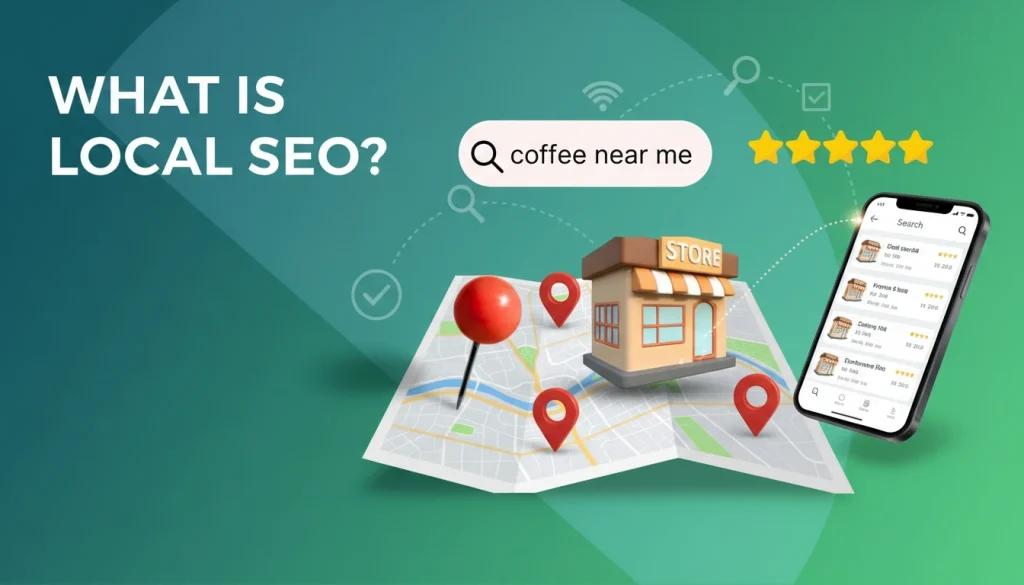
Local SEO is essentially the digital version of putting a giant “Open” sign right in front of people who are walking down your street looking for exactly what you sell. While regular search engine optimization (SEO) tries to get your website seen by anyone in the world, Local SEO focuses specifically on the people in your town, city, or neighborhood.
Think about the last time you needed a plumber or a quick pizza. You probably grabbed your phone and searched for “plumber near me” or “best pizza in [your city].” Local SEO is the set of steps you take to make sure your business is the one that pops up at the very top of those specific search results.
To make this happen, Google looks at three main things:
- Proximity: How close is your shop to the person searching?
- Relevance: Does your business actually provide the service they asked for?
- Prominence: Do you have good reviews and a solid reputation online?
When you get these right, Google puts you in the “Local Pack”: that box at the top of the page with a map and three featured businesses. This is the “gold mine” of the internet because most people click one of those three options and call them immediately. It’s not about being the biggest company in the country; it’s about being the most trusted and visible expert in your own backyard.
Key Components of a Strong Local SEO Strategy
To build a strong local SEO strategy, you need to focus on a few key areas that work together. Understanding the different types of seo is important, but for a neighborhood business, these four areas are the engine that gets results. By organizing your online info this way, you make it very easy for Google to trust your business.
1. Optimizing Your Google Business Profile
Your Google Business Profile is like your digital storefront, and it needs to look its best. Start by writing a clear description of what you do, and make sure to include the names of the services you offer and the city you are in. You should also upload fresh photos of your work, your team, and your office so people know you are real. Posting regular updates or special offers on your profile keeps it active and shows Google you are still in business. If you travel to your customers, make sure to list every specific neighborhood or town you serve in the “service areas” section. This helps you show up for people even if they aren’t standing right next to your shop. Keeping all this info updated is the fastest way to get more phone calls.
2. On-Page Local SEO
On-page SEO just means making small changes to your own website to show Google where you are located. You should add your city name and the specific services you provide to the titles and main text of your pages. If you have shops in different towns, it is a great idea to create a separate “landing page” for each location with its own unique details. You can also use something called “Schema markup,” which is just a simple way to tag your address and phone number so search engines can read them easily. Another smart move is to embed a Google Map directly on your contact page so customers can get directions without leaving your site. All of these small tweaks help search engines connect your website to your physical location. When your website and your map listing match, your rankings usually go up.
3. Local Citations and Directory Listings
Citations are just mentions of your business on other websites, like an online phone book or a community directory. This is a form of off-page SEO because it happens away from your website, but it still helps your rankings. You want to get your business listed on big sites like Yelp or Bing, but also on smaller sites that are just for your specific type of work. The most important rule here is to keep your NAP (Name, Address, and Phone number) exactly the same on every single site.
4. Local Link Building
Local link building is about getting other websites in your town to link back to your own website. You can do this by forming partnerships with other local business owners who aren’t your direct competitors. For example, a local plumber might link to a trusted tile shop, and the tile shop could link back to the plumber. Getting involved in your community by sponsoring a local sports team or a charity event is another great way to get a link from their website. These links are very powerful because they show Google that you are a respected member of the local community. It isn’t just about getting any links; it’s about getting links from people who live and work right near you. This builds a network of trust that helps your business stand out from national brands.
Local SEO vs. Organic SEO: What’s the Difference?
While they both help you get found on Google, Local SEO and Organic SEO are actually two different tools. The main difference is who you are trying to reach and where they are located.
1. Organic SEO (The Big Picture)
Organic SEO is what you use when you want to rank for a topic, no matter where the reader is. If you write a blog post about “how to fix a leaky faucet,” you want someone in New York, London, or Kathmandu to find it.
- The Goal: To be an authority on a subject.
- The Result: You show up in the standard “blue links” on Google.
- The Focus: Keywords, high-quality content, and links from other websites.
2. Local SEO (Your Neighborhood)
Local SEO is strictly for businesses that serve a specific area. It’s for the plumber, the dentist, or the coffee shop owner. When someone searches for “plumber near me,” Google knows they aren’t looking for an article; they are looking for a person to come to their house.
- The Goal: To get customers to visit your shop or call your local number.
- The Result: You show up in the Google Map Pack (the map at the top of the page).
- The Focus: Your address, local phone number, and customer reviews.
| Feature | Organic SEO | Local SEO |
| Who sees it? | Anyone in the world. | People in your specific town. |
| Where do you rank? | In the list of websites. | On the Google Map. |
| What matters most? | Great articles and links. | Correct address and reviews. |
How Google Ranks Local Businesses (The 3 Pillars)
Google ranks local businesses based on how well they match a searcher’s location, their specific needs, and how much other people trust that business. It doesn’t just pick businesses at random to show at the top of the map. It uses a specific formula to decide which shop or service is the best fit for the person searching. Even if you are a small business, you can beat the big guys if you understand these three simple “pillars.”
1. Relevance (Are you a match?)
This is all about whether your business actually does what the customer is looking for. If someone searches for “emergency plumber,” Google won’t show a hardware store that just sells pipes.
- Keep it simple: Make sure your business name, description, and the services you list on your website are clear. If you fix roofs, say “roof repair,” not just “home services.”
2. Distance (Are you nearby?)
This is the “local” part of Local SEO. Google tries to give the user the most convenient option. If a person is standing on Main Street searching for coffee, Google will prioritize the cafes within a few blocks.
- Note: You can’t change your physical location, but you can make sure your address is 100% correct so Google knows exactly where you are.
3. Prominence (Are you trusted?)
Think of this as your digital reputation. Google wants to send its users to a business that other people already like.
- Reviews: Having a lot of 5-star reviews tells Google you are a safe bet.
- Links: If local news sites or neighborhood blogs talk about you, it proves you are an important part of the community.
Why is Local SEO Important for Small Businesses?
Local SEO is important because it connects your business with the people living and working right in your neighborhood who are ready to buy. Instead of fighting with giant global companies, you are focusing your energy on winning over the local customers who can actually visit your shop. This targeted approach means you don’t waste time or money reaching people who live too far away to ever use your services.
1. Increased Local Visibility
When you use local SEO, you make it much easier for people in your town to find you when they search online. Most people don’t look past the first few results on Google, so being at the top of the map is a huge deal. It’s like having the biggest, brightest sign on the busiest street in town, but on everyone’s phone. If your business doesn’t show up in those top local spots, you are basically invisible to most of your potential customers. By showing up where people are looking, you stay ahead of the crowd and get noticed first. This visibility builds a brand that your neighbors will start to recognize and trust over time.
2. More Foot Traffic and Calls
The main goal of local SEO is to get people to actually do something, like walk into your store or pick up the phone. When someone finds your business on a map, they can see exactly how to get to you with just one click. This leads to more people visiting your physical location because you’ve made it so easy for them to find your front door. It also makes it simple for them to call you directly from the search results to ask questions or book an appointment. You aren’t just getting “clicks” on a website; you are getting real people interacting with your business in the real world. This is the fastest way to turn an online search into a real-life sale.
3. Higher Conversion Rates
A “conversion” is just a fancy way of saying a person went from looking at your business to actually spending money. Local searches have much higher conversion rates because the person searching usually needs help right now. If someone searches for “locksmith” at 2:00 AM, they aren’t just browsing; they are ready to pay for help immediately. Because local SEO targets people with this “ready to buy” mindset, you don’t have to work as hard to convince them to choose you. You are providing the right solution at exactly the right time and place. This makes your marketing much more effective than trying to reach random people who might not need you for months.
4. Competitive Advantage in Local Markets
Many small businesses still don’t take local SEO seriously, which gives you a great chance to jump ahead of them. Even if a competitor has been in town longer than you, you can outrank them by having better reviews and a cleaner Google profile. It levels the playing field, allowing a small mom-and-pop shop to appear right alongside or even above a massive national chain. By focusing on your local community, you build a loyal customer base that the big corporations can’t easily take away. You are playing a game they often ignore, which lets you claim the top spot in your specific market. It’s about being the “big fish” in your own local pond.
5. Impact of Mobile Searches
Almost everyone uses their smartphone to find things while they are on the go. Whether someone is driving around looking for gas or sitting in a park looking for lunch, they are using mobile search to decide where to go next. Google prioritizes local results on mobile because it knows the user is looking for something nearby and convenient. If your business isn’t optimized for these mobile searches, you are missing out on the majority of modern customers. Local SEO ensures that your address and phone number look great and work perfectly on a small screen. Since mobile search is only growing, staying on top of it is the only way to keep your business moving forward.
How to Improve Local SEO Rankings Step by Step
To improve your local SEO, you need to follow a clear checklist that tells Google exactly where you are and what you do. By taking these steps one by one, you build a digital footprint that makes it easy for neighbors to find your business. This process isn’t about doing one big thing, but about doing several small things correctly to stay ahead of the shop down the street.
1. Claim and Verify Your Google Business Profile
The first and most important step is to tell Google that your business actually exists by claiming your profile. This is a free listing that shows your business name, map location, and photos to everyone searching nearby. After you sign up, Google will usually send you a code in the mail or by phone to “verify” that you are really the owner at that address. Once you are verified, you gain full control over the information people see, like your opening hours and phone number. Without a verified profile, you are almost invisible in the local map results. It is the foundation of everything else you will do to get found online.
2. Conduct Local Keyword Research
Local keyword research is just a way of finding out the exact words your neighbors use when they need your help. Instead of just trying to rank for “shoes,” you want to find out if people are searching for “running shoes in [Your City]” or “best shoe store near me.” You can use free tools or even just look at the suggestions Google gives you when you start typing in the search bar. Knowing these specific phrases helps you write better descriptions for your profile and your website. When you use the same language as your customers, Google is more likely to connect you with them. It takes the guesswork out of your marketing and helps you focus on what works.
3. Optimize Website for Local Intent
Optimizing your website means making it very clear to both Google and your customers where you are located. You should put your city name and your neighborhood in the titles of your pages and throughout your written content. It’s also smart to include a map of your location right on your “Contact Us” page so people can see exactly how to get to you. Make sure your site loads fast on mobile phones, as most local searches happen while people are out and about. If your website is easy to read and clearly shows your local address, Google will feel much more confident sending people your way. This step bridges the gap between someone seeing you on a map and actually visiting your site.
4. Build Local Citations
A citation is simply a mention of your business name, address, and phone number on other websites. You want to get listed on big sites like Yelp, Yellow Pages, and Bing Places, as well as local community or Chamber of Commerce sites. These mentions act like digital “votes” that prove to Google you are a legitimate part of the local community. The key is to make sure your information is exactly the same on every single site you join. If one site has an old phone number and another has a new one, it can hurt your rankings. Building these links takes time, but it builds a strong reputation that is hard for competitors to beat.
5. Encourage Customer Reviews
Reviews are like personal recommendations that the whole world can see, and they are a huge ranking factor for Google. You should kindly ask your happy customers to leave a star rating and a few words about their experience after you finish a job. Don’t be afraid to reply to these reviews, even the bad ones, because it shows you care about your customers. Google loves to see a steady stream of new reviews coming in, as it proves your business is active and doing a good job. The more positive feedback you have, the more likely new customers are to click on your name instead of someone else’s. It is the best way to build instant trust with a complete stranger.
6. Create Locally Relevant Content
Instead of writing general articles, try creating content that specifically talks about things happening in your town. You could write a blog post about a local charity event you supported or a guide to the best parks near your shop. This shows Google that you aren’t just a generic company, but a real neighbor who is involved in the community. Using local landmarks or street names in your writing helps search engines pin your business to a specific geographic area. It also makes your website much more interesting to the people who actually live near you. Content like this proves you are an expert in your local market, not just your industry.
7. Monitor Local Search Performance
Once you have done the work, you need to keep an eye on your results to see what is actually working. You can use the “Insights” section inside your Google Business Profile to see how many people called you or asked for directions. It also shows you which keywords people used to find your listing in the first place. By checking these numbers once a month, you can see if you are moving up in the rankings or if you need to fix something. Monitoring your performance helps you spend your time on the tasks that bring in the most customers. It turns Local SEO from a guessing game into a clear plan for growth.
Final Words
So, what is local SEO? It is the most effective way to make sure your neighbors find your business the exact moment they need your help. It isn’t just about being on the internet; it is about owning your local corner of the digital world. By claiming your map listing, keeping your information correct, and listening to your customers through reviews, you stop being invisible and start being the go-to expert in your town.
The internet is the new “word of mouth,” and local SEO is how you control that conversation. If you follow the steps we discussed, you won’t just rank higher on a screen; you will see more real people walking through your front door every single day.
Frequently Asked Questions (FAQs)
1. How long does it take to see results from Local SEO?
It usually takes about 3 to 6 months to see a big change. While you can update your business info today, it takes time for Google to trust your new data and for you to collect enough reviews to beat your competitors.
2. Do I need a website for Local SEO to work?
You can show up on Google Maps with just a Google Business Profile, but having a website is much better. A website gives Google more proof that you are a real business and helps you rank for more specific keywords.
3. Is Google Business Profile really free?
Yes, it is 100% free. Google does not charge you to list your business on the map. If someone calls you asking for money to “verify” or “keep” your listing, it is likely a scam.
4. What should I do if I get a bad review?
Don’t panic. The best thing to do is reply calmly and professionally. Try to fix the problem for the customer. Other people reading the review will see that you care about your customers and handle mistakes well.
5. Does my business address have to be public?
If you work from home or travel to customers (like a plumber), you can hide your exact address. You just tell Google the “service areas” or towns you cover, so you still show up for people in those spots.
6. How often should I post photos or updates?
Try to post at least one new photo or update every week. It shows Google and your customers that your business is active and healthy. Profiles with recent photos usually get more clicks.
7. Can I do Local SEO myself, or do I need an expert?
You can definitely do the basics yourself! Following the steps in this guide, like setting up your profile and asking for reviews, will get you very far. You only need an expert if you have many locations or a very busy market.
8. Why is my business not showing up on the map yet?
It could be a few things: your profile might not be verified yet, your information might be inconsistent, or you might not have enough “prominence” (reviews and links) compared to your neighbors.